As WAJIBU launches its accountability reports today, the Accountability Report - Social Service Delivery 2024/25 turns attention to what happens after public resources are allocated: whether people receive the services those resources were meant to provide.
A health facility can have a new machine and still be unable to offer the service it was bought for. A village can have a water point and still have no water. A school can have classrooms but lacks enough teachers and learning materials.
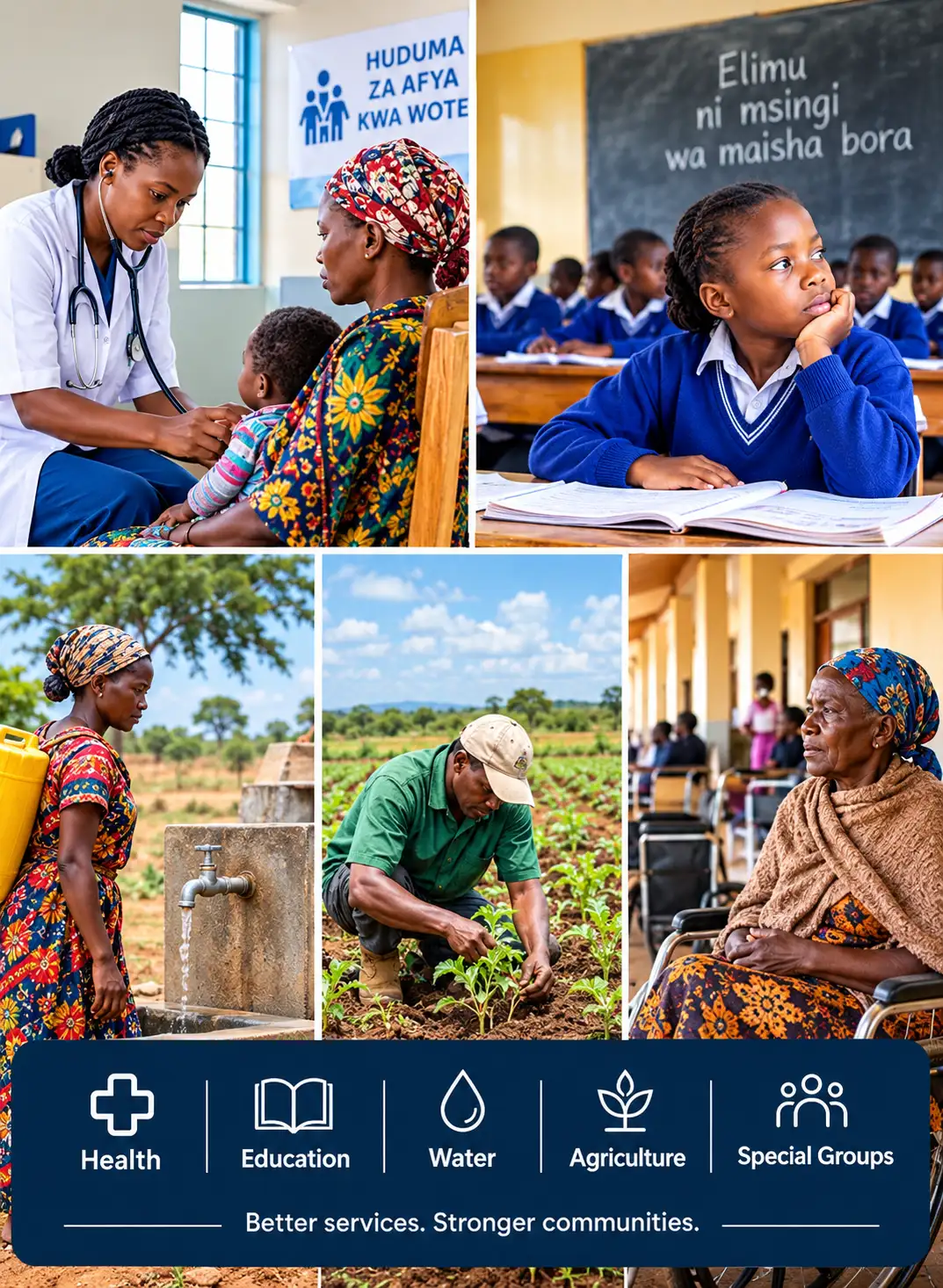
These are some of the gaps brought together in the WAJIBU’s Accountability Report - Social Service Delivery 2024/25, prepared in collaboration with Policy Forum. Drawing on CAG audits and performance audits, the report examines health, education, water, agriculture and services for special groups, asking a practical question: what are citizens receiving from the public resources committed to these services?
Health Sector: the equipment is there, but the service may still be out of reach
The report finds a major shortage of health workers. By 2024/25, the health sector needed 379,766 workers but had 172,122, leaving a gap of 207,644 workers, or 54.7% of the requirement. The shortage is particularly important at primary health facilities, where many citizens first seek care.
In 30 facilities reviewed by CAG, the workload for nurses and midwives was especially high. In some maternity wards, one nurse or midwife was serving up to 10 pregnant women, while antenatal and postnatal clinics recorded ratios of up to one health worker for 20 women.
The report also identifies medical equipment worth more than Sh5.17 billion that was not being used in 28 local government authorities. Reasons included a lack of trained personnel, incomplete buildings, shortages of laboratory reagents, and unreliable electricity and water infrastructure. The consequence is very direct: services that the equipment was intended to bring closer to citizens remain unavailable, forcing some patients to travel further for diagnosis and treatment.
Water Sector: infrastructure exists, but 714,921 people are still affected
The water findings tell a similar story.
Of 4,007 community-managed water points reviewed, 516 equivalents to 13% were not functioning, affecting approximately 714,921 people who were expected to benefit from them. Across the water authorities and community water organisations examined, annual demand stood at about 85.57 million cubic metres, while actual production was only 24.52 million cubic metres which is a shortfall of approximately 61.04 million cubic metres, equivalent to 71% of demand.
The effect extends beyond the water point itself. Where reliable water is unavailable, households spend more time looking for it, with women and children carrying much of that burden. Time that could have been spent in school, at work or on household activities is instead spent securing a basic service.
Education Sector: resources reaching schools below what was planned
The report also identifies shortages in the resources needed for learning. In 2024/25, there was a Tsh72.05 billion funding gap for textbooks and other essential education needs. In the areas examined, the allocation for textbook procurement and the free education grant also fell significantly below identified requirements.
The shortage of teachers adds another pressure. The report links inadequate numbers of teachers, which include teachers with specialized skills with crowded classrooms which reduced individual attention and limited access to inclusive education for students with special needs.
Agriculture Sector: a financing commitment did not translate into the planned support
Agriculture presents another example of the distance that can develop between a programme’s target and what farmers receive.
The Agricultural Inputs Trust Fund (AGITF) planned to provide Sh10.3 billion in loans to smallholder farmers, but by the end of 2024/25 it had disbursed only Sh407 million about 4% of the target. The report also identifies delays in agricultural inputs, shortages of extension officers and climate-related pressures affecting farmers’ productivity.
Special groups: a fund can exist without reaching everyone it was designed for
For women, youth and people with disabilities, the report highlights weaknesses in the management of the Women, Youth and Persons with Disabilities Development Fund (WYDF).
In 2024/25, 72 LGAs did not transfer Sh13.88 billion to the fund. In Moshi Municipal Council, for example, Sh2.17 billion was transferred to 234 groups before completed legal agreements in place, creating difficulties for accountability and loan recovery.
Older people face their own set of gaps. Across 13 government residential facilities reviewed by CAG, the report found ageing infrastructure, missing services and limited specialist support. Of 220 older people assessed, 213 equivalents to 96% did not have formal residential permits. Only 72 had health insurance, while shortages of assistive devices further increased dependence on caregivers.
The question after the launch
Taken together, these findings show that improving service delivery is not only about increasing allocations. It is also about whether facilities have the staff to operate, whether equipment can actually be used, whether funds reach the intended programmes, and whether infrastructure continues working after it is built.
That is where the Accountability report’s purpose becomes important. Its recommendations identify actions for Ministries, Agencies, Local Government Authorities and other responsible institutions. The next stage is to follow those actions and ask whether they lead to measurable changes in the services people receive.
Read more: Explore the Accountability Report on Social Service Delivery 2024/25 for the full findings across health, education, water, agriculture and services for special groups.